

Rules and ethics
Who may approve a business insurance advert, and what it must substantiate
Check business insurance advertising for England against financial-promotion scope, FCA communication rules, evidence, pricing and disclosures.
Business insurance advertising in England can engage the financial-promotion restriction, FCA Handbook rules and the CAP or BCAP advertising codes. Whether a post is editorial, generic, an invitation, an inducement or a regulated firm's communication depends on its content and context. Obtain perimeter and compliance approval before release.
This article focuses on England. The FCA and ASA rules apply across the United Kingdom, but devolved law in Scotland, Wales and Northern Ireland and cross-border campaigns can add separate requirements.
What to take away
- Decide if content is a financial promotion and record the reasoning before release.
- Every price, saving, ranking and coverage statement needs dated evidence.
- Qualifications must be prominent, not buried in a footnote.
- Publication approval needs a date and review trigger.
- Shortened versions need their own review or an approved locked template.
Resolve who may communicate or approve it
- Name the advertiser, product provider, intermediary and publisher.
- Identify the intended audience and where the material can be received.
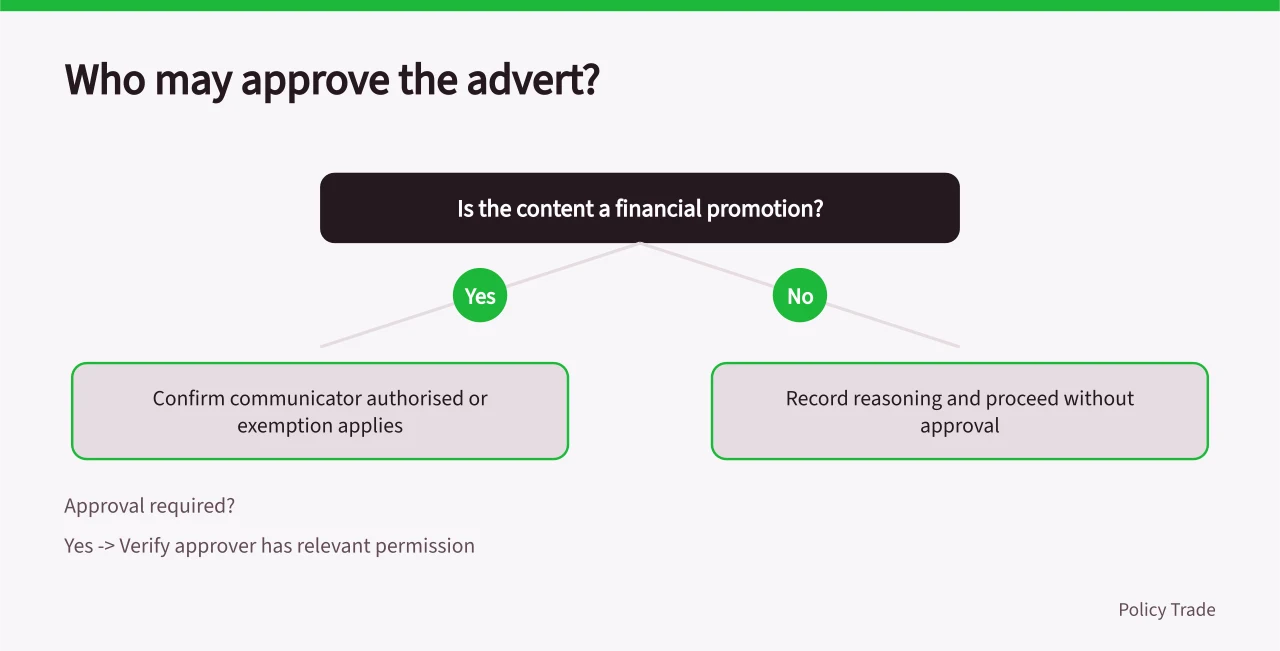
- Decide whether the content is a financial promotion and record the reasoning.
- Confirm whether the communicator is authorised or an exemption applies.
- Where approval is required, verify that the approver has the relevant permission.
- Keep the approved final version, date, channels and audience controls.
The FCA's approving financial promotions page summarises section 21 of the Financial Services and Markets Act 2000: communication must generally be by an authorised person, approved lawfully or covered by an exemption.
The main routes are an authorised person, a section 21 approver, an appointed representative acting within its principal's permission, or an exemption.
A section 21 approver is an authorised person approving a promotion for an unauthorised communicator. The exemption must come from the Financial Services and Markets Act 2000 (Financial Promotion) Order 2005. The approver needs permission for the regulated activity being promoted.
For example, an unauthorised marketing agency drafts an advert for a broker. The broker is an FCA authorised person with permission to arrange non-investment insurance contracts. The broker approves the advert under section 21. The agency can then communicate it.
Make the proposition understandable
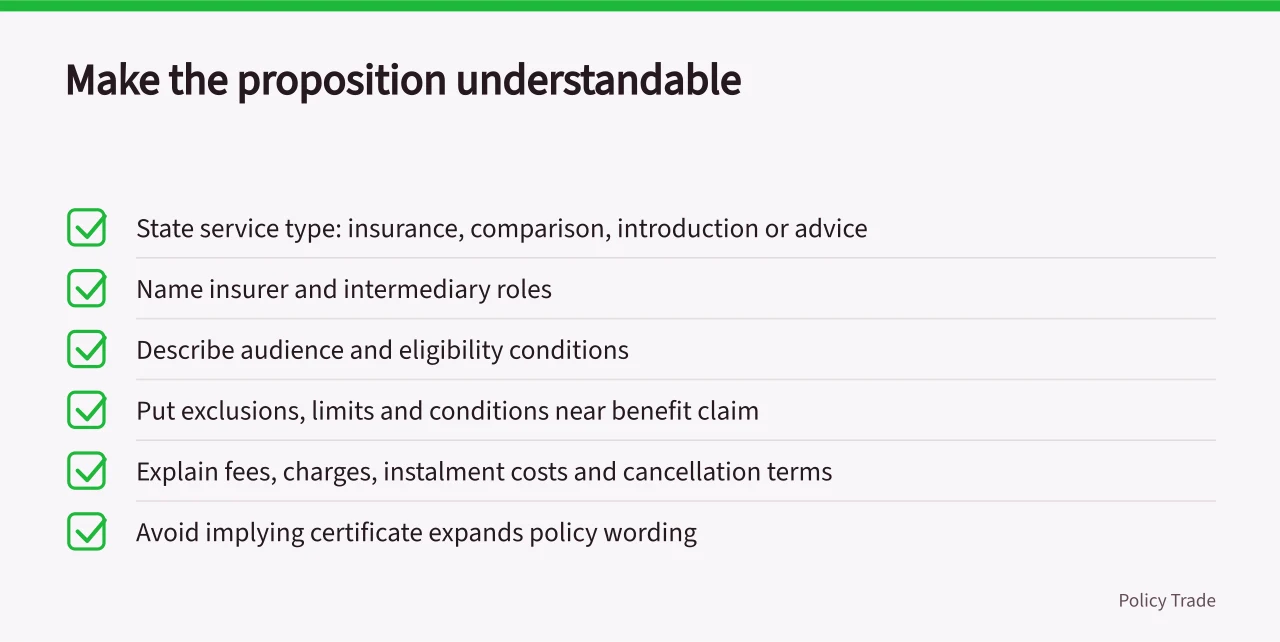
- State whether the service is insurance, comparison, introduction or advice.
- Name the insurer and intermediary roles where relevant.
- Describe the audience and principal eligibility conditions.
- Put material exclusions, limits and conditions near the benefit claim.
- Explain fees, charges, instalment costs and cancellation terms.
- Avoid implying that a certificate expands the policy wording.
FCA Handbook ICOBS 2.2 requires covered customer communications and promotions to be clear, fair and not misleading. The current section includes specific guidance for claims that a firm can reduce premium, provide the cheapest premium or lower costs.
For example, a non-compliant advert says: "Our policy covers every business risk." A compliant version says: "This policy covers fire, theft and public liability for a named trade. It excludes flood and cyber. See the policy wording." The compliant version names the cover, the trade and the main exclusions near the claim.
Substantiate claims before drafting
- Link every price, saving, ranking and coverage statement to dated evidence.
- Define the sample and proportion behind "customers save" wording.
- Distinguish a live quotation from an example or starting price.
- Do not call a panel the whole market unless that is proven and accurate.
- State when service claims come from the provider rather than independent testing.
- Set an expiry or review trigger for volatile claims.
Do not repair a weak headline with a remote footnote. A qualification must be prominent enough to correct the impression at the point it is created.
Substantiate claims before drafting
- Link every price, saving, ranking and coverage statement to dated evidence
- Define sample and proportion behind 'customers save' wording
- Distinguish live quotation from example or starting price
- Do not call a panel the whole market unless proven
- State when service claims come from provider not independent testing
- Set expiry or review trigger for volatile claims
Apply the advertising code
The CAP Code section 14 covers non-broadcast financial-product marketing. Rule 14.2 states: "Advertisements must be clear, fair and not misleading." Rule 14.1 confirms the section applies to financial products, services and investments. FCA-controlled technical matters remain within the statutory regime.
- Identify paid, affiliate and sponsored placement clearly.
- Keep editorial order independent from undisclosed commercial influence.
- Check comparative claims use like-for-like products and current evidence.
- Review imagery, fear, urgency and social-responsibility implications.
- Apply the correct broadcast rules to radio or television material.
Control publication and change
Use separate drafting, factual, compliance and release roles. Test links, mobile presentation, accessibility and whether qualifications remain visible in every shortened or syndicated version. Prevent partners from rewriting approved wording without review.
Monitor the promotion after release. Pause it if a price, eligibility rule, policy document, provider status or evidence base changes. Archive withdrawals and corrections. Publication approval is a dated control, not permanent permission to repeat the claim.
Create a variant register for paid search, social posts, email, affiliate copy and comparison snippets. Each shortened version can create a new impression or remove a qualification, so it needs its own review or an approved locked template.
Record where automated feeds supply prices or product names, who monitors failures and how quickly distribution can be stopped. Sample live placements, not just the master artwork.
Consequences of non-compliant advertising
Breaching the financial promotion restriction is a criminal offence under section 25 of the Financial Services and Markets Act 2000. On conviction, the maximum is two years' imprisonment, a fine, or both. The FCA can also impose unlimited fines for rule breaches, vary or cancel permissions, require redress and publish censure.
The ASA publishes rulings and requires non-compliant ads to be withdrawn or amended. Persistent breaches can be referred to Trading Standards. Broadcast breaches can be referred to Ofcom.
Common questions
Who may approve a business insurance advert?
An authorised person, a section 21 approver, an appointed representative within its principal's permission, or a communicator covered by a Financial Promotion Order 2005 exemption. The approver needs permission for the activity being promoted. Check the position before release.
What must an advert substantiate?
Each price, saving, ranking and coverage claim needs dated evidence. Define the sample, distinguish a live quote from an example, and avoid claiming to be the whole market unless proven. Label provider-sourced service claims.
How should qualifications and footnotes be handled?
Keep material conditions close to the claim they qualify. Test shortened versions for dropped conditions. A footnote that is hard to reach will not fix a misleading headline.